Enclosed Auto Transport Statistics: Costs, Market Share & Industry Trends

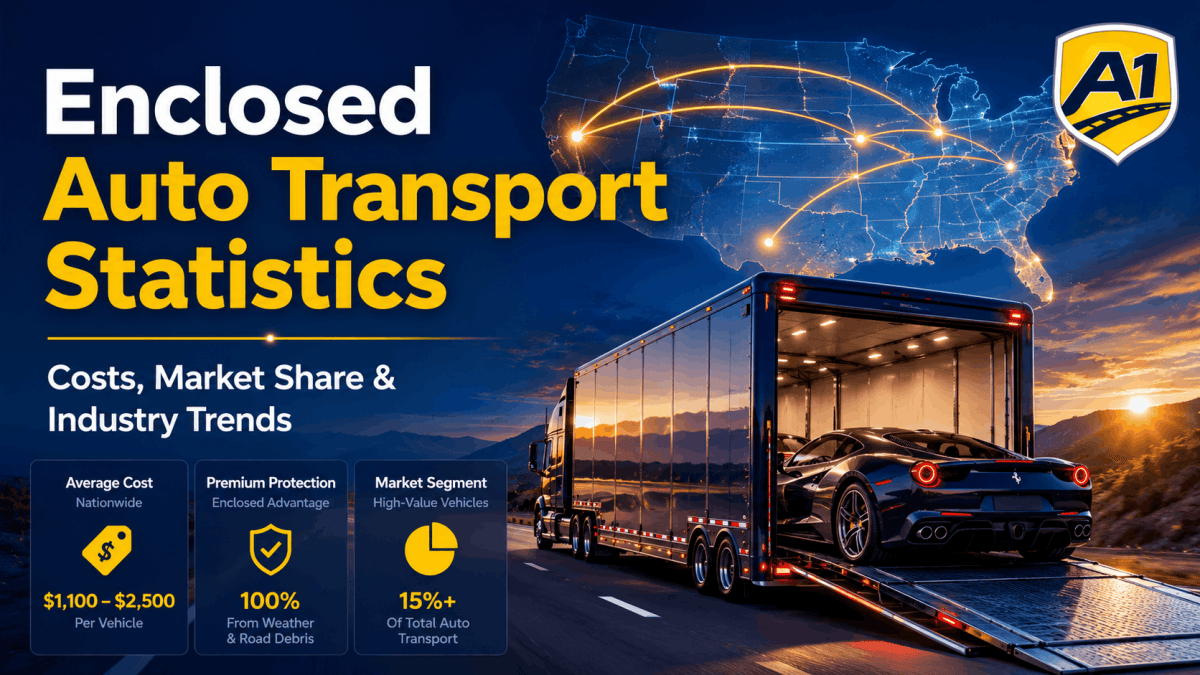
Enclosed auto transport is the preferred shipping method for luxury, exotic, classic, and high-value vehicles that require additional protection during transit. This dataset compiles industry statistics, pricing benchmarks, market trends, delivery timelines, and vehicle shipping patterns to provide a data-driven overview of the enclosed auto transport market in the United States.
Enclosed Auto Transport Cost Statistics
Cost is one of the most important factors when choosing enclosed auto transport. While enclosed carriers typically command higher rates than open transport, they provide additional protection, specialized handling, and lower vehicle capacity, all of which influence pricing across interstate routes.
Key Statistics: Enclosed Auto Transport Costs
- Enclosed auto transport typically costs 30%–60% more than open carrier shipping for comparable routes and vehicle types.
- Average enclosed transport rates generally range from $1.00 to $2.50 per mile, depending on distance, route density, vehicle dimensions, and carrier availability.
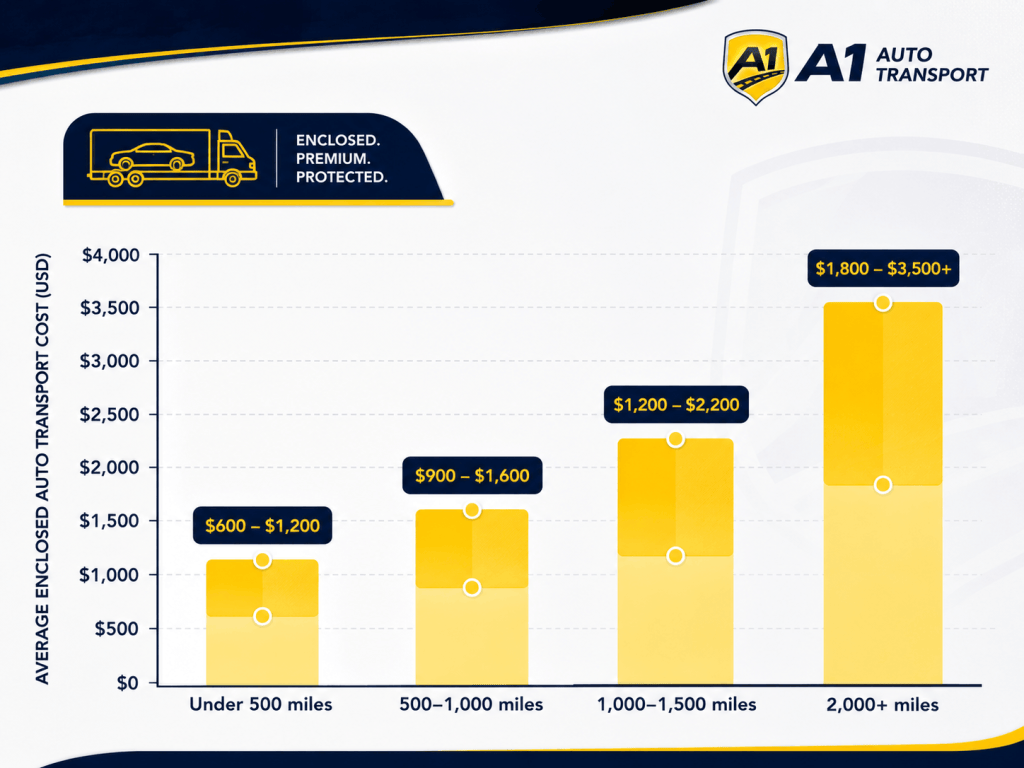
- Shipments under 500 miles commonly cost between $600 and $1,200 when transported in an enclosed trailer.
- Routes between 1,000 and 1,500 miles often fall within the $1,200 to $2,200 range for enclosed transport.
- Cross-country enclosed shipments exceeding 2,000 miles frequently cost between $1,800 and $3,500+, depending on vehicle size and service level.
- Single-car enclosed transport services generally command the highest rates because the trailer is dedicated to one vehicle.
- Vehicle dimensions and weight significantly impact pricing, with oversized luxury SUVs and specialty vehicles often requiring higher-cost transport solutions.
- Seasonal demand can increase enclosed transport rates during spring, summer, and major collector-car auction periods.
New Deals are now available for shipping all types vehicles using our vetted reliable shippers. Compare price estimates & Unlock up 25% off.
Open vs Enclosed Auto Transport Comparison
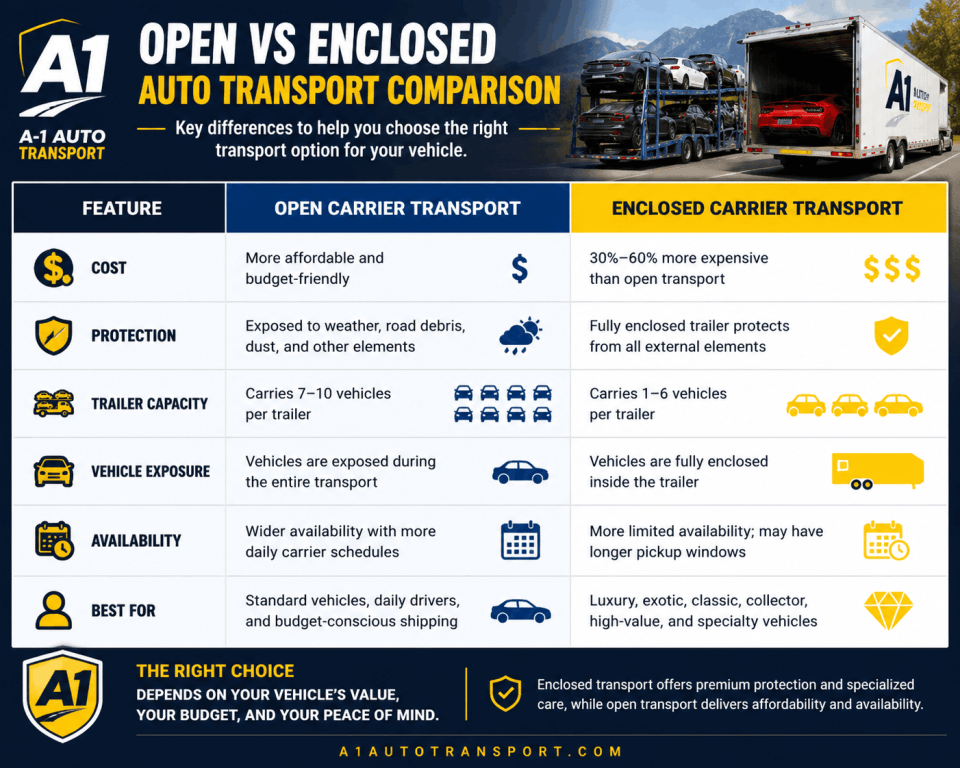
Open and enclosed auto transport serve different shipping needs. Open carriers remain the most common and cost-efficient option, while enclosed carriers are used for vehicles that require added protection, privacy, and specialized handling during transit.
Key Statistics: Open vs Enclosed Auto Transport
- Open carrier transport accounts for the majority of U.S. vehicle shipments because it offers higher carrier availability and lower average pricing.
- Enclosed auto transport is a smaller premium segment, commonly used for luxury cars, exotic vehicles, classic cars, collector vehicles, and high-value auction purchases.
- Enclosed shipping typically costs 30%–60% more than open transport because enclosed trailers carry fewer vehicles and require more specialized equipment.
- Open carriers commonly transport 7–10 vehicles per trailer, while enclosed carriers often carry 1–6 vehicles, depending on trailer type and service level.
- Open transport exposes vehicles to weather, dust, and road debris, while enclosed transport provides full trailer-side protection during transit.
- Enclosed carriers are more limited in availability than open carriers, which can increase pickup windows on certain routes.
- Open transport is usually preferred for standard daily-use vehicles, while enclosed transport is preferred for vehicles where condition, value, privacy, or restoration quality is a priority.
- For high-value vehicles, the added cost of enclosed shipping is often justified by reduced exposure risk and more controlled handling.
Enclosed Auto Transport Market Share & Industry Overview
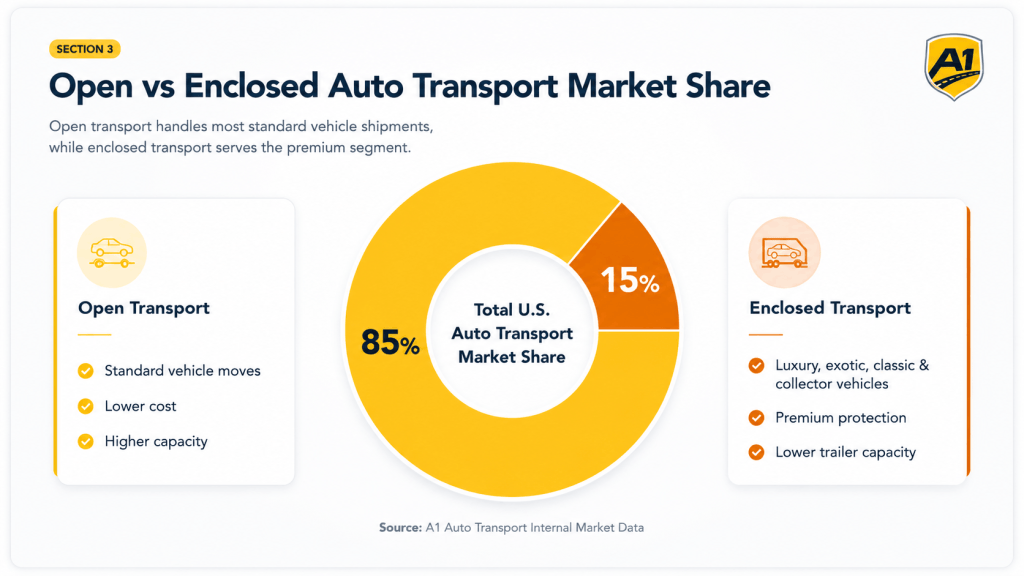
Enclosed auto transport represents a smaller but higher-value segment of the U.S. vehicle shipping market. While open carriers handle most standard vehicle moves, enclosed carriers serve a specialized market built around protection, limited trailer capacity, and high-value vehicle handling.
Key Statistics: Enclosed Auto Transport Market Share
- Open carrier transport makes up the largest share of U.S. auto shipping because it offers lower costs, more route availability, and higher vehicle capacity.
- Enclosed auto transport is commonly estimated to represent a smaller premium segment of the market, often used for luxury, exotic, classic, antique, and collector vehicles.
- Enclosed trailers usually carry fewer vehicles per load, commonly between 1 and 6 vehicles, compared with 7 to 10 vehicles on many open multi-car haulers.
- Because enclosed carriers have lower capacity and more specialized equipment, enclosed shipping rates are consistently higher than open transport rates.
- Demand for enclosed transport is closely tied to luxury vehicle ownership, classic car values, online vehicle auctions, collector car sales, and high-value relocations.
- Single-car enclosed trailers sit at the premium end of the market because they offer dedicated transport, lower handling frequency, and added privacy.
- Multi-car enclosed trailers are more common for long-distance routes, dealer transfers, auction purchases, and collector vehicle movements.
- Enclosed auto transport remains a niche service by volume but a high-value category by average shipment price.
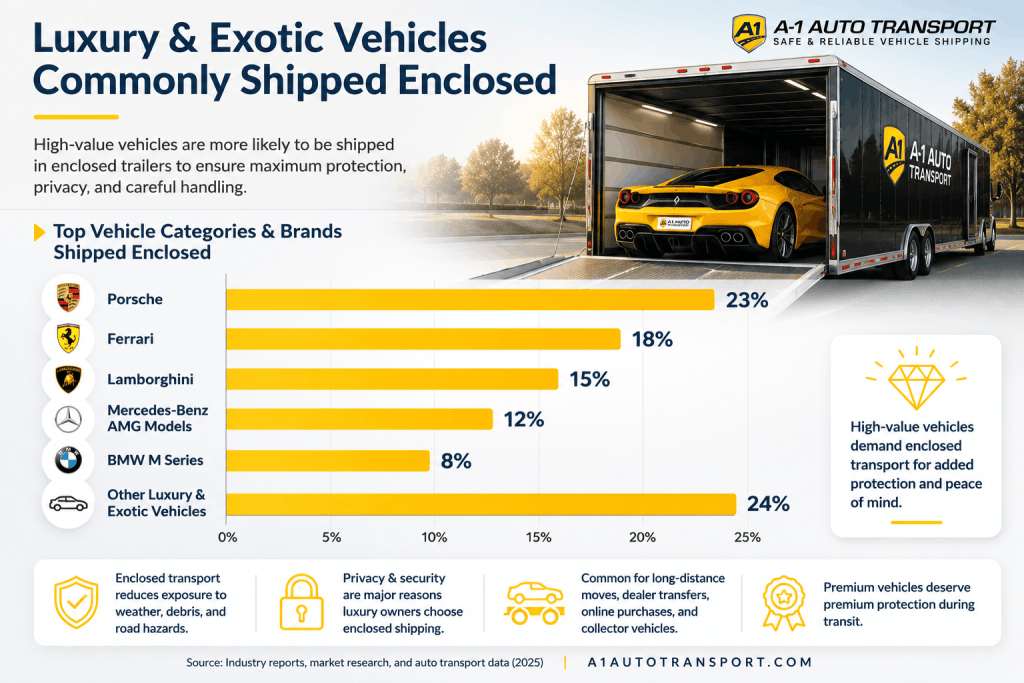
Luxury & Exotic Vehicle Shipping Statistics
Luxury and exotic vehicles are among the most common candidates for enclosed auto transport because owners prioritize protection, privacy, and careful handling. As high-value vehicle ownership grows across the U.S., enclosed shipping demand continues to be shaped by premium car sales, collector activity, and long-distance relocations.
Key Statistics: Luxury & Exotic Vehicle Shipping
- Luxury and exotic vehicles account for a large share of enclosed auto transport demand because they carry higher replacement values and greater sensitivity to cosmetic damage.
- Enclosed transport is commonly used for premium brands such as Porsche, Ferrari, Lamborghini, McLaren, Bentley, Rolls-Royce, Aston Martin, and Mercedes-Benz AMG models.
- High-value vehicles are more likely to be shipped enclosed when moving across long-distance routes, especially between major luxury markets such as California, Florida, Texas, New York, Arizona, and Nevada.
- Exotic vehicle owners often choose enclosed trailers to reduce exposure to weather, road debris, dust, and public visibility during transit.
- Enclosed transport is especially common for vehicles with low ground clearance, custom paint, carbon-fiber bodywork, specialty wheels, or limited-production trim packages.
- Luxury SUVs and performance EVs are becoming a larger part of enclosed transport demand due to their higher curb weights, premium finishes, and rising transaction values.
- Dealer transfers, private purchases, online vehicle sales, and out-of-state relocations all contribute to enclosed shipping demand for luxury and exotic cars.
- The higher average value of luxury and exotic vehicles makes the enclosed transport premium easier to justify compared with standard open carrier shipping.
Classic Car & Collector Vehicle Transport Trends
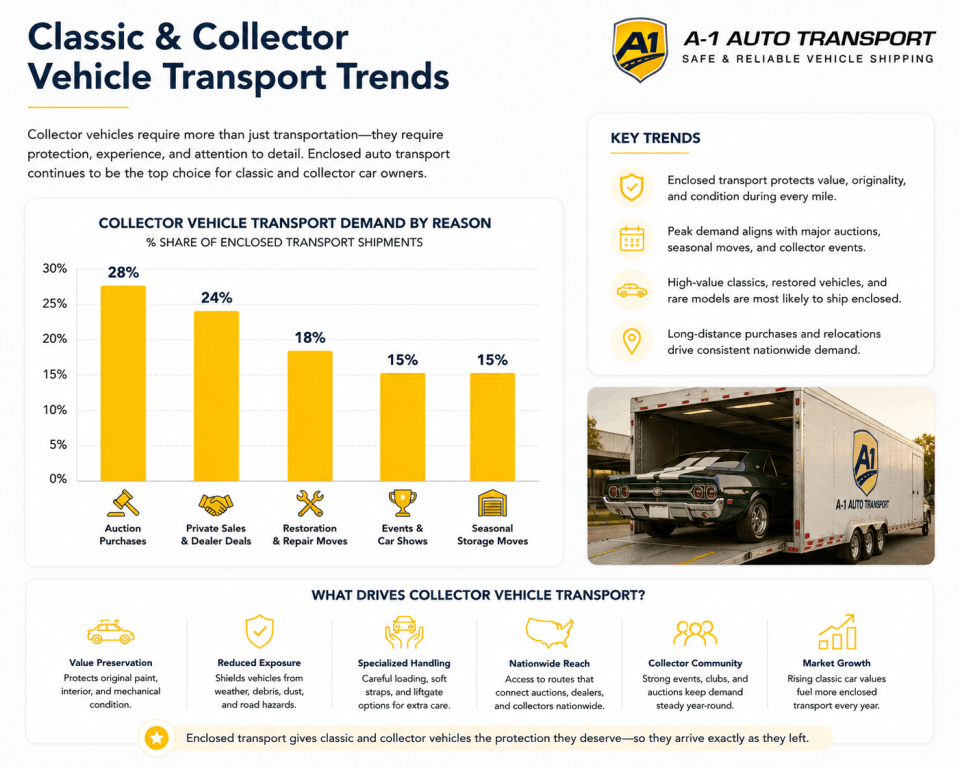
Classic and collector vehicles are a major driver of enclosed auto transport demand because condition, originality, and market value matter heavily to owners and buyers. Auction purchases, restoration projects, private sales, and long-distance relocations all contribute to steady enclosed shipping activity in the collector car market.
Key Statistics: Classic Car & Collector Vehicle Transport
- Classic cars, antique vehicles, and collector cars are among the most common vehicle categories shipped in enclosed trailers.
- Enclosed transport is often preferred for collector vehicles because it reduces exposure to weather, road debris, dust, and handling risks during transit.
- Auction-related vehicle moves create consistent enclosed transport demand, especially around major collector car events and sales.
- Collector vehicles with original paint, restored interiors, custom finishes, or rare trim packages are more likely to be shipped enclosed than standard used vehicles.
- High-value classic cars often require additional care during loading and unloading, including soft straps, liftgate service, and low-clearance handling.
- Long-distance enclosed transport is common for classic car buyers purchasing vehicles from out-of-state dealers, auctions, or private sellers.
- States with strong collector car markets, warm-weather storage demand, and major auction activity generate higher enclosed transport volume.
- Enclosed shipping is especially common for vehicles being transported to restoration shops, concours events, private collections, and seasonal storage locations.
Damage Risk & Vehicle Protection Statistics
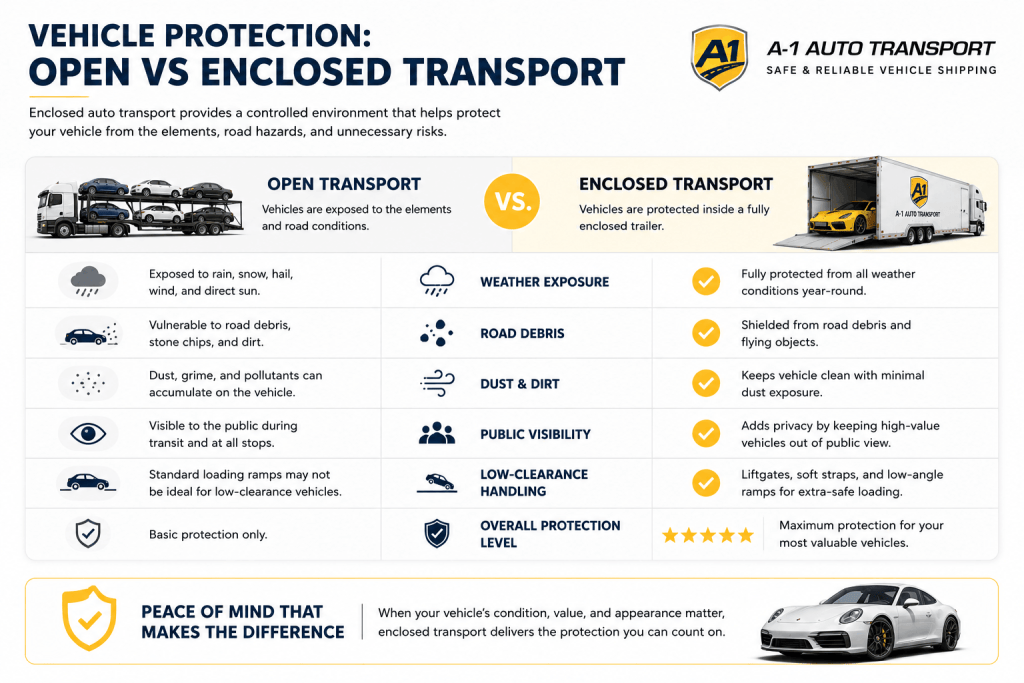
Vehicle protection is the main reason enclosed auto transport exists as a premium shipping option. Unlike open carriers, enclosed trailers reduce exposure to weather, road debris, dust, and public handling risks, making them especially valuable for vehicles where condition and appearance are critical.
Key Statistics: Damage Risk & Vehicle Protection
- Enclosed auto transport provides full trailer-side protection from rain, snow, hail, road debris, dust, and direct sun exposure during transit.
- Open carriers expose vehicles to normal highway conditions, while enclosed carriers create a controlled transport environment for high-value vehicles.
- Vehicles with custom paint, ceramic coatings, restored finishes, carbon-fiber parts, or rare trim packages are more likely to be shipped enclosed.
- Enclosed trailers reduce cosmetic exposure risk, especially for stone chips, dust accumulation, weather spotting, and road grime.
- Luxury, exotic, and collector vehicle owners often choose enclosed shipping to reduce the chance of appearance-related issues during long-distance transport.
- Enclosed transport can also provide added privacy by keeping high-value vehicles out of public view while in transit.
- Low-clearance vehicles often benefit from enclosed carrier equipment such as liftgates, race ramps, soft straps, and controlled loading angles.
- The protection advantage of enclosed shipping is most valuable on long-distance interstate routes where vehicles spend more time exposed to road and weather conditions.
Seasonal Demand Trends for Enclosed Auto Transport
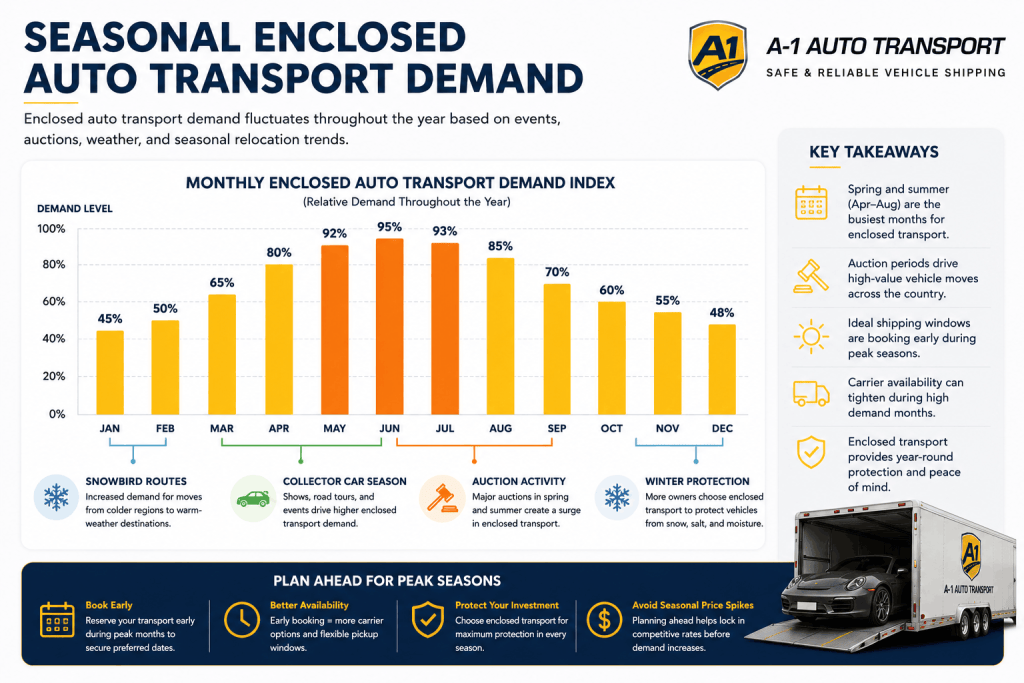
Enclosed auto transport demand follows seasonal patterns tied to collector car events, luxury relocations, auction calendars, and weather-sensitive vehicle movement. Demand often rises when owners want extra protection during peak travel, relocation, or buying seasons.
Key Statistics: Seasonal Enclosed Auto Transport Demand
- Spring and summer are commonly the busiest periods for enclosed auto transport because classic, exotic, and collector vehicles are moved for events, shows, auctions, and seasonal use.
- Demand often increases before and after major collector car auction periods, when high-value vehicles are purchased and moved across state lines.
- Winter can create additional enclosed shipping demand in colder regions because owners prefer protection from snow, road salt, moisture, and winter debris.
- Snowbird routes between northern states and warmer destinations such as Florida, Arizona, Texas, and California can increase enclosed transport activity during fall and winter.
- Enclosed shipping demand may rise around luxury vehicle relocations, private sales, and online purchases throughout the year.
- Carrier availability can tighten during peak demand months, especially for single-car enclosed trailers and specialty low-clearance equipment.
- Seasonal pricing pressure is usually strongest when high transport demand overlaps with limited enclosed carrier capacity.
- Customers shipping rare, restored, or high-value vehicles often book enclosed transport earlier during peak seasons to secure preferred pickup windows
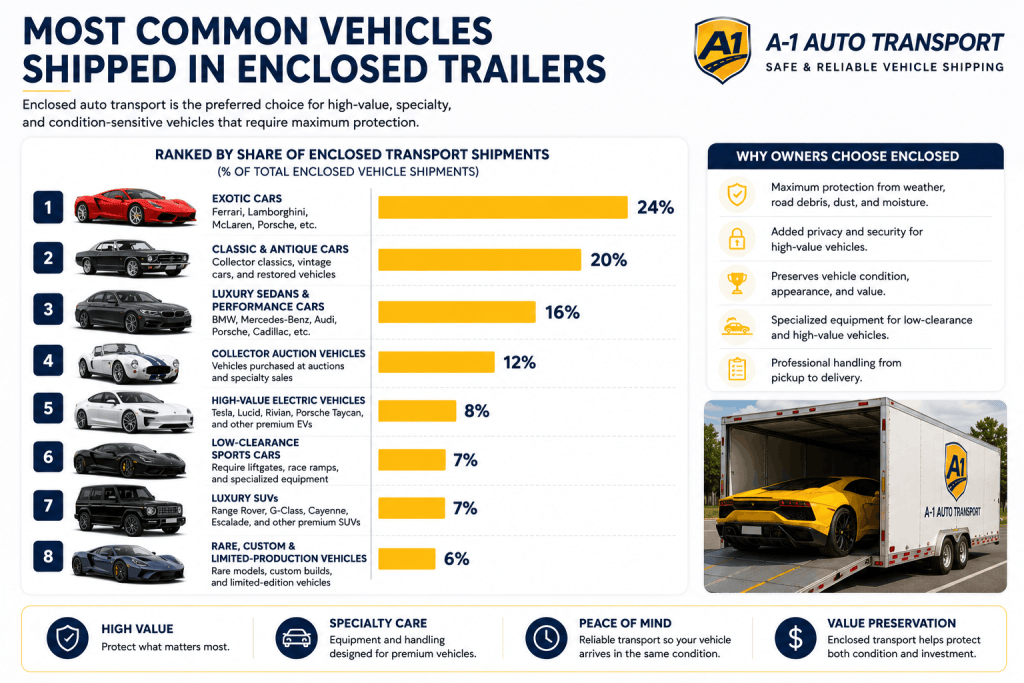
Most Common Vehicles Shipped in Enclosed Trailers
Enclosed trailers are most often used for vehicles where value, condition, privacy, or specialty handling matters more than the lowest possible shipping price. These shipments typically include exotic cars, classic vehicles, luxury SUVs, auction purchases, and specialty vehicles that need extra protection during transit.
Key Statistics: Most Common Enclosed Vehicle Categories
- Exotic cars are one of the most common enclosed transport categories because owners prioritize protection from weather, road debris, and public exposure.
- Classic and antique vehicles are frequently shipped enclosed due to restoration quality, originality, rare parts, and collector value.
- Luxury sedans and performance cars are commonly moved in enclosed trailers, especially for long-distance relocations and out-of-state purchases.
- Collector vehicles purchased through auctions often require enclosed transport because buyers want condition preserved from sale to delivery.
- High-value electric vehicles are becoming more common in enclosed transport due to premium finishes, higher curb weights, and advanced exterior components.
- Low-clearance sports cars often require enclosed carriers with liftgates, race ramps, or specialized loading equipment.
- Luxury SUVs such as Range Rover, Mercedes-Benz G-Class, Porsche Cayenne, and Cadillac Escalade models are increasingly shipped enclosed on premium routes.
- Rare, custom, or limited-production vehicles are more likely to move by enclosed trailer because replacement cost, cosmetic risk, and owner expectations are higher.
Delivery Timeline & Carrier Capacity Statistics
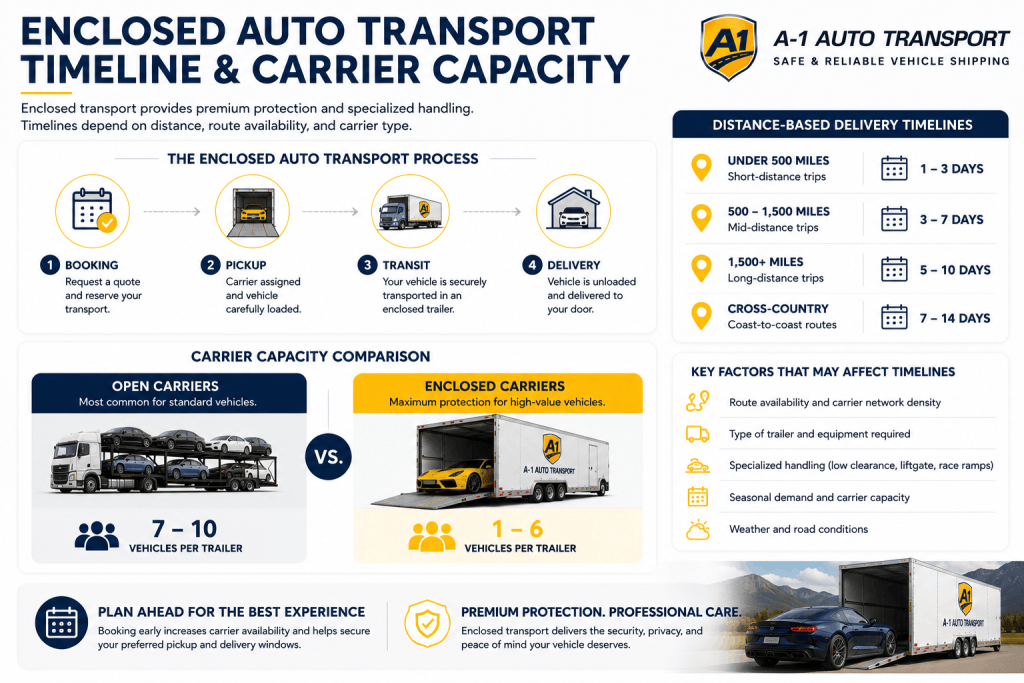
Enclosed auto transport timelines depend on distance, route availability, carrier type, and vehicle handling requirements. Because enclosed trailers carry fewer vehicles than open carriers, scheduling can require slightly more planning, especially for high-value, low-clearance, or single-car enclosed shipments.
Key Statistics: Delivery Timelines & Carrier Capacity
- Enclosed auto transport pickup windows are often slightly longer than open transport because enclosed carrier availability is more limited.
- Short-distance enclosed shipments under 500 miles commonly take 1–3 days once picked up.
- Mid-distance enclosed shipments between 500 and 1,500 miles typically take 3–7 days in transit.
- Long-distance enclosed shipments over 1,500 miles often require 5–10 days, depending on route density and carrier scheduling.
- Cross-country enclosed auto transport can take 7–14 days from pickup to delivery, especially when specialty equipment or limited route availability is involved.
- Open carriers commonly move 7–10 vehicles per trailer, while enclosed carriers usually carry 1–6 vehicles depending on trailer type.
- Single-car enclosed trailers offer the most direct service but usually cost more because the full trailer is dedicated to one vehicle.
- Multi-car enclosed trailers are more efficient for long-distance routes, auction moves, dealer transfers, and collector vehicle shipments.
- Vehicles requiring liftgates, race ramps, soft straps, or low-clearance loading may require additional scheduling time.
Insurance & Coverage Statistics for Enclosed Auto Transport
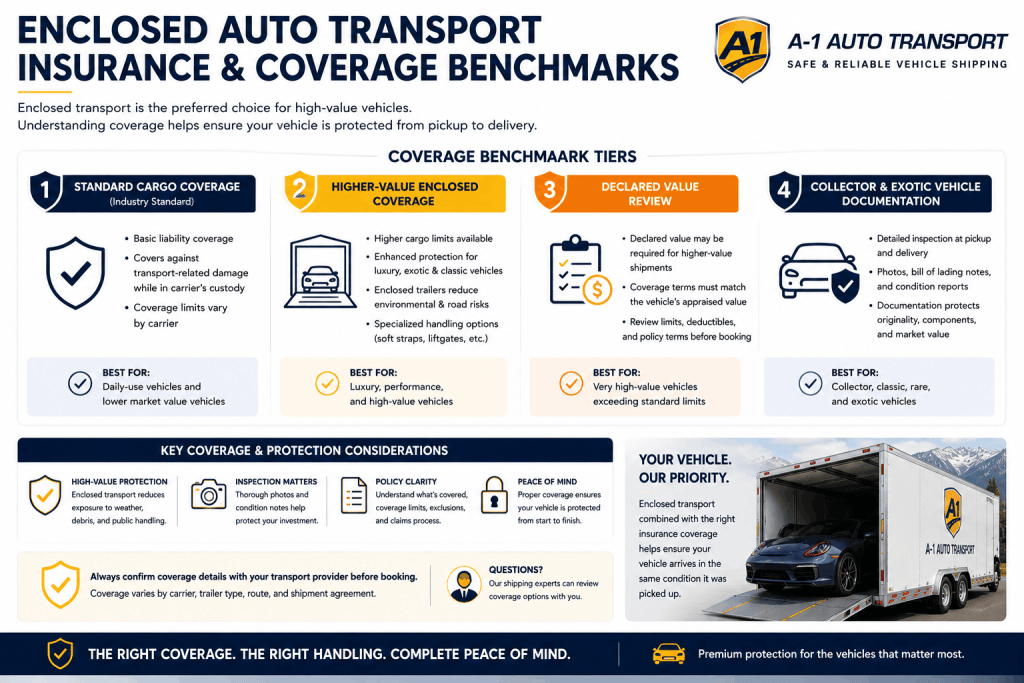
Insurance coverage is a major consideration in enclosed auto transport because many enclosed shipments involve high-value vehicles. While every shipment should be reviewed individually, enclosed carriers often serve customers who need higher protection standards, documented handling, and coverage that matches the vehicle’s value.
Key Statistics: Enclosed Auto Transport Insurance & Coverage
- Enclosed auto transport is commonly used for vehicles with higher market values, including luxury cars, exotic vehicles, classic cars, collector vehicles, and auction purchases.
- Many enclosed transport customers request higher cargo coverage because the vehicles being shipped often exceed the value of standard daily-use vehicles.
- Cargo insurance limits vary by carrier, trailer type, route, and shipment agreement, so customers should confirm coverage before booking.
- High-value enclosed shipments may require additional documentation, including vehicle condition photos, bill of lading notes, and declared vehicle value.
- Collector and classic vehicles often need careful inspection at pickup and delivery because originality, paint condition, trim, and interior details can significantly affect value.
- Enclosed carriers may offer higher-value handling options such as soft straps, liftgates, covered loading, and reduced handling frequency.
- Single-car enclosed transport can reduce handling exposure because the vehicle is loaded once and delivered directly with fewer intermediate stops.
- For exotic, luxury, and collector vehicles, insurance review is especially important when the vehicle has custom modifications, rare parts, restored components, or unusually high appraised value.
- Customers shipping high-value vehicles should verify whether personal auto insurance, collector car insurance, or the transport carrier’s cargo policy applies during transit.
Key Enclosed Auto Transport Statistics
Enclosed auto transport remains a smaller but higher-value segment of the vehicle shipping market. It is most commonly used when vehicle value, condition, privacy, or specialty handling outweighs the need for the lowest shipping price.
- Enclosed auto transport typically costs 30%–60% more than open carrier shipping for comparable routes.
- Average enclosed transport pricing generally ranges from $1.00 to $2.50 per mile, depending on distance, vehicle size, route availability, and service level.
- Open carriers commonly transport 7–10 vehicles per trailer, while enclosed carriers usually carry 1–6 vehicles per trailer.
- Short-distance enclosed shipments under 500 miles commonly cost between $600 and $1,200.
- Long-distance enclosed shipments over 2,000 miles frequently range from $1,800 to $3,500+.
- Cross-country enclosed auto transport commonly takes 7–14 days from pickup to delivery.
- Enclosed transport is most often used for luxury cars, exotic vehicles, classic cars, collector vehicles, high-value EVs, and auction purchases.
- Spring and summer are among the busiest periods for enclosed transport due to auctions, car shows, seasonal driving, and collector vehicle movement.
- Winter weather can increase enclosed shipping demand in colder regions because owners want protection from snow, road salt, moisture, and road debris.
- Single-car enclosed transport usually costs more than multi-car enclosed transport because the trailer is dedicated to one vehicle.
- Vehicles with low ground clearance, custom paint, carbon-fiber parts, rare trim, or restored finishes are more likely to require enclosed carrier equipment.
- Enclosed auto transport is a niche service by shipment volume but a premium service by average shipment value.

 Share on Facebook
 Share on LinkedIn
 Share on Twitter
 Dave C.
  Courtney J.
  Jeff D.
  Maria L.
  Google
  Instagram
  BBB
BBB