
How To Transport Farm Equipment: Safety Tips (2022)

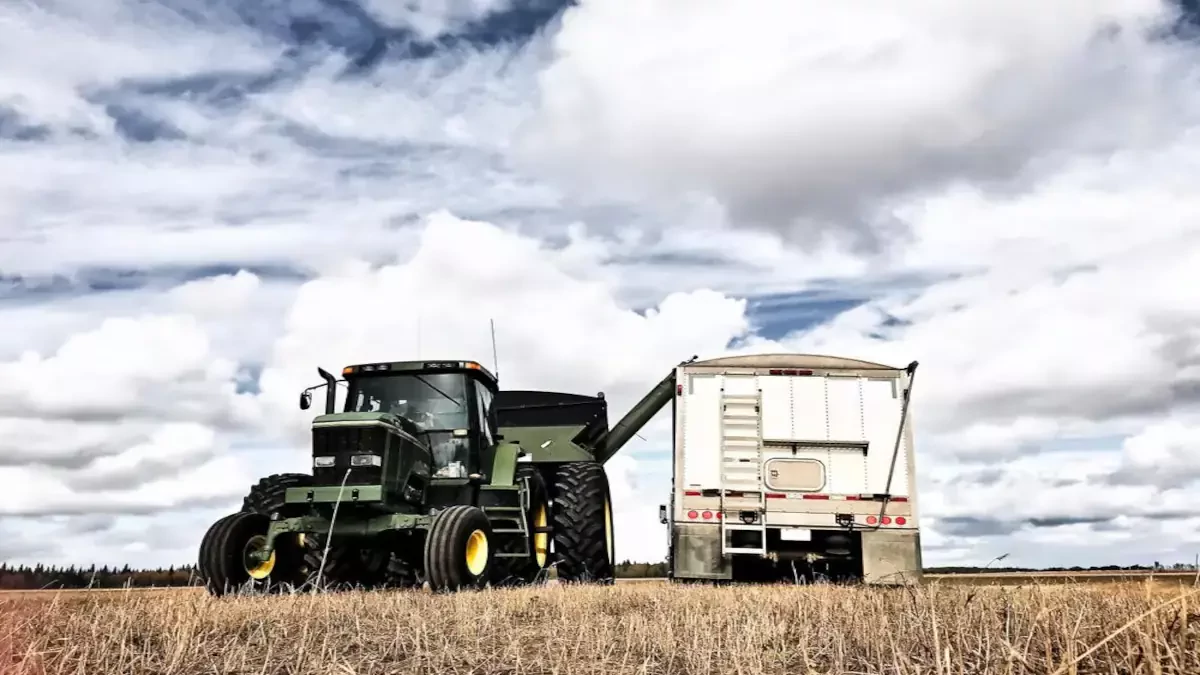
It’s quite common to see farm equipment traveling on public roads in rural communities, especially during harvesting months like summer and spring.
However, farm equipment cannot travel long distances, so most owners find transporting farm machinery a daunting task.
If you want to know how to haul conveniently, follow our tips below.
How Long Does It Take To Deliver?
- Flatbed and lowboy trailers are standard for farm equipment transport; lowboys handle loads up to 48,000 lbs, 50' long, and 9' tall.
- Farm equipment typically delivers in 1–3 business days for short hauls, with longer interstate routes extending timelines based on distance and trailer availability.
- State DOT permits are required for oversized agricultural loads; carriers must comply with FMCSA regulations and verify axle weight, width, and height clearances before transport.
Based on most companies, it’ll take one to three business days for short-distance deliveries.
Alternatively, equipment may take a few more days for longer distances for obvious reasons.
While professional services promise faster shipment time frames, It’s hard to give an exact shipment time frame for moving unless the final destination and trailer hauling have already been decided.
New Deals are now available for shipping all types vehicles using our vetted reliable shippers. Compare price estimates & Unlock up 25% off.
In Conclusion
Hauling needs careful planning to execute the hauling safely. Planning allows you to score cheaper options for your needs.
We also suggest preparing it, checking its attachments and implements, and securing permits if necessary before moving.
The farm equipment type should also be considered. Moving four-wheel drive tractors could be more expensive than compact utility tractors, depending on the company's service package.
To haul hassle-free, go with A1-AT. Our experienced specialists can handle all types of industrial equipment.
References:
Frequently Asked Questions
How do you transport farm equipment safely?
Farm equipment is transported safely by measuring the machine in its shipping configuration, choosing a trailer that fits those dimensions, loading on firm level ground, and using rated securement. For wheeled or tracked machinery weighing 10,000 pounds or more, FMCSA §393.130 requires at least four tiedowns and restraint against forward, rearward, lateral, and vertical movement; accessories must also be secured. The carrier then plans the legal route and any required permits. A1's farm equipment shipping service covers common agricultural machinery and transport options.
How much does it cost to transport farm equipment?
As of September 16, 2026, legal-size farm equipment hauling commonly runs about $4-$5 per loaded mile for short hauls under roughly 250 miles, $2.50-$4 for 250-1,000 miles, and $1.50-$3 for longer hauls. Oversize tractors, combines, and sprayers can cost more when the move needs an RGN or lowboy, permits, escorts, or additional axles. Loaded dimensions, weight, operability, and site access also affect the quote. A1's heavy equipment shipping rates guide explains the main pricing inputs.
What are the different ways to transport a tractor?
Most tractors travel on a flatbed, step-deck, lowboy, or RGN trailer, with the choice based on loaded height, weight, width, and how the tractor can be loaded. Flatbeds work for many legal-size tractors and implements, while step-decks and lowboys provide more height clearance for taller machinery. An RGN is useful for heavy self-propelled equipment because the front section detaches for near-ground-level loading. A1's heavy machinery shipping guide explains how trailer selection changes with machine dimensions.
Do I need oversize permits to transport farm equipment across state lines?
Farm equipment needs oversize or overweight permits when the loaded commercial vehicle exceeds the legal limits in the states it will travel through. On the National Network, the federal commercial-vehicle width standard is 102 inches, and cargo extending beyond that width requires an overwidth permit. The federal government does not issue oversize or overweight permits; individual states handle them. There is also no single federal vehicle-height limit, so height limits, escort requirements, and permitted travel conditions must be checked for every state on the route.
What should I check when comparing farm equipment transport companies?
When comparing farm equipment transport companies, first verify the carrier's USDOT status and operating authority through FMCSA before releasing the machinery. For an interstate for-hire shipment, confirm that the assigned carrier is authorized for property transport and review its licensing and insurance information. Ask what trailer will carry your exact machine, how loading and securement will be handled, and what cargo coverage applies. Give the company accurate dimensions, weight, attachments, operating condition, and site-access details so the quoted equipment matches the actual job.
1) Plan Out the Details

All farm equipment owners must plan every detail to properly and safely haul/transport farm machinery.
First, you must determine how much you are willing to pay for the transportation.
Generally, the overall shipping price determines whether you would want to hire professional shipping businesses or not.
Next, you need to determine what trailer truck would be used as the transport vehicle. Flatbed and lowboy tractors are generally used for loading and transporting agricultural equipment.
If the total weight of the farming equipment is not more than 48,000 lbs, with 40’ to 50’ in length, up to 9’ high, and up to 8.66’ wide, a lowboy hauler should be used.
Lastly, you need to prepare your equipment. Always include pictures of your farming equipment in your plan so that you’ll have evidence in case it gets damaged from any accident during transport.
2) Find A Professional Transport Company
Another tip we recommend when hauling/transporting farming equipment is to find a professional transport company.
It’s easy to find shipping companies now because they have legit websites you can easily find on the internet.
To save time, you can also get a free shipping estimate from some shipping companies to determine whether your allotted money for the farm equipment transport is enough.
You can easily get the best rates and services in the comfort of your home.
Professional transport businesses also provide skilled drivers and knowledgeable staff for high-quality services. Their job is to provide a safe hauling service.
Most hauling services also offer insurance and door-to-door delivery when you avail of their farm equipment transport service packages.
Some hauling businesses will also take care of necessary licenses if your heavy equipment is oversized, so the farm equipment transport would be as smooth as possible.
3) Secure Permits
Another tip we recommend is securing permits before transporting farm equipment.
Some states require specific licenses and paperwork before the haul, especially if the load/equipment is oversized.
The rules and regulations of transporting farm equipment/tractor vary from state to state, so we always recommend working with your local Department of Transportation (DOT) [1] offices. You can also contact the DOT office where the farm tractor will be shipped.
4) Consider Attachments & Implements
The next things you must consider when shipping farming equipment are the attachments and implements.
Some farm equipment/tractors can be shipped separately, so you need to check with your transport equipment company.
You might be required to take out integral parts, components, or vulnerable pieces, like tires, and ship/haul them separately.
We recommend arranging another delivery to haul/ship them prior to the main body, so you won’t be paying additional costs for the trailer to stay onsite until the attachments arrive.
Additional service or time may cost you more because of the additional job.
The farm equipment’s height, weight, and width also determine the trailer that must be used to ship it, so always check for the equipment’s clearance before the haul.
If the agricultural machinery is too wide, you can remove the wheels and tires prior to the tractor shipment. You can either ship them separately or hire another trailer to load them onto.
You can also remove the equipment’s booms so it won’t be too long and could fit into the trailer truck.
Removing some parts from the chassis will also help solve any overweight designation. Shipping tractors with lighter loads is always cheaper than wide-load heavy machinery.
5) Prepare Your Farm Equipment
Did you know that properly preparing any farm equipment helps every farm owner find the best but cheapest trailer possible to ship farming machinery?
By determining the attachments and implements of the equipment, you’ll know whether it’s best to ship the farm equipment/tractor separately or not. You will also know the best trailer to transport farm machinery safely.
It’s also recommended to wash your farm equipment and take out all your personal belongings and all the parts that need to be delivered separately prior to the shipment.
Flatbed trailers [2] are usually the cheapest farm equipment transport vehicles, but a lowboy trailer or a low-loader can also be used to ship a farm tractor/vehicle.
6) Agricultural Equipment Usually Shipped

Most agricultural equipment usually shipped across different states are:

 Share on Facebook
 Share on LinkedIn
 Share on Twitter
 Dave C.
  Courtney J.
  Jeff D.
  Maria L.
  Google
  Instagram
  BBB
BBB 




