Montgomery v Caribe Transport: What the Supreme Court Ruling Means for Auto Transport Customers

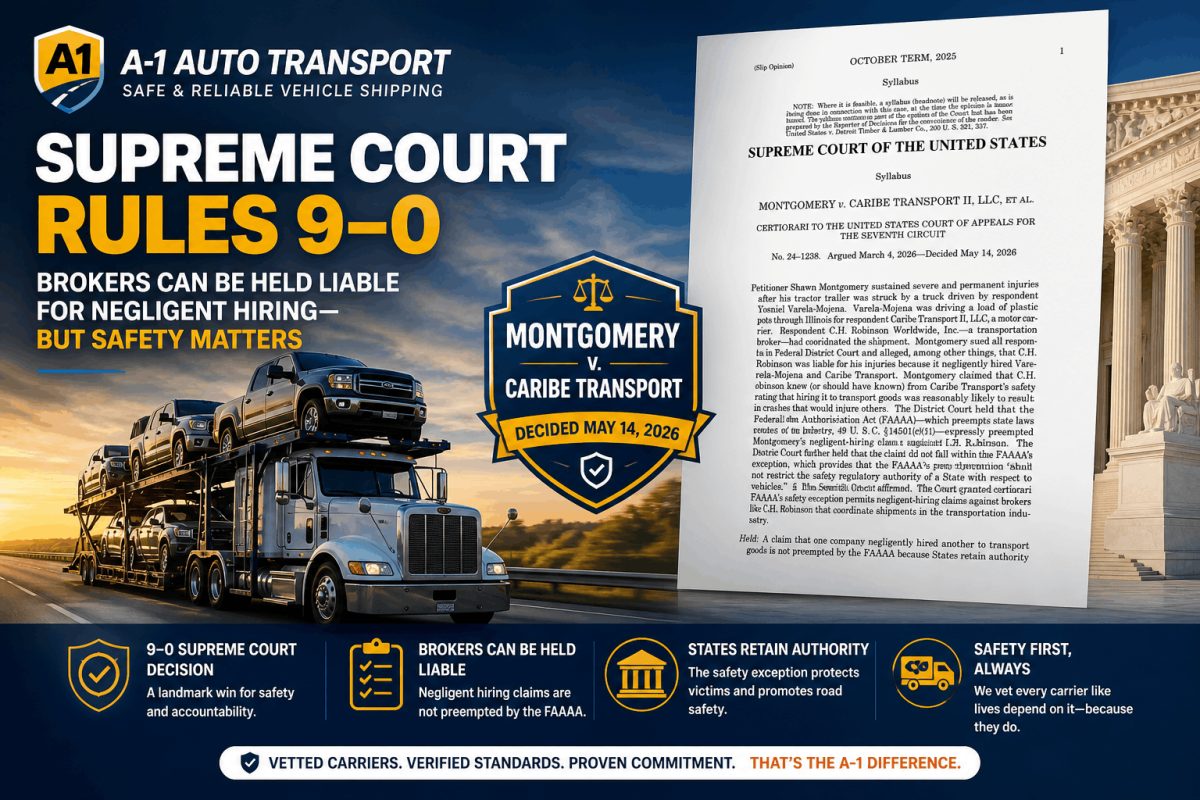
On May 14, 2026, the Supreme Court ruled 9-0 that freight brokers can be sued under state law for negligently hiring unsafe motor carriers. The decision in Montgomery v Caribe Transport changes the rules for every company that arranges vehicle transport, including auto transport networks like ours. We've spent the past two days answering customer questions about what the ruling actually does, what it doesn't, and how it affects someone shipping a personal vehicle. The Court has now made the carrier-vetting standard we've used for more than 25 years the standard every broker has to meet. Customers benefit. Carriers with strong safety records benefit. Brokers that skipped real vetting are the ones in trouble.
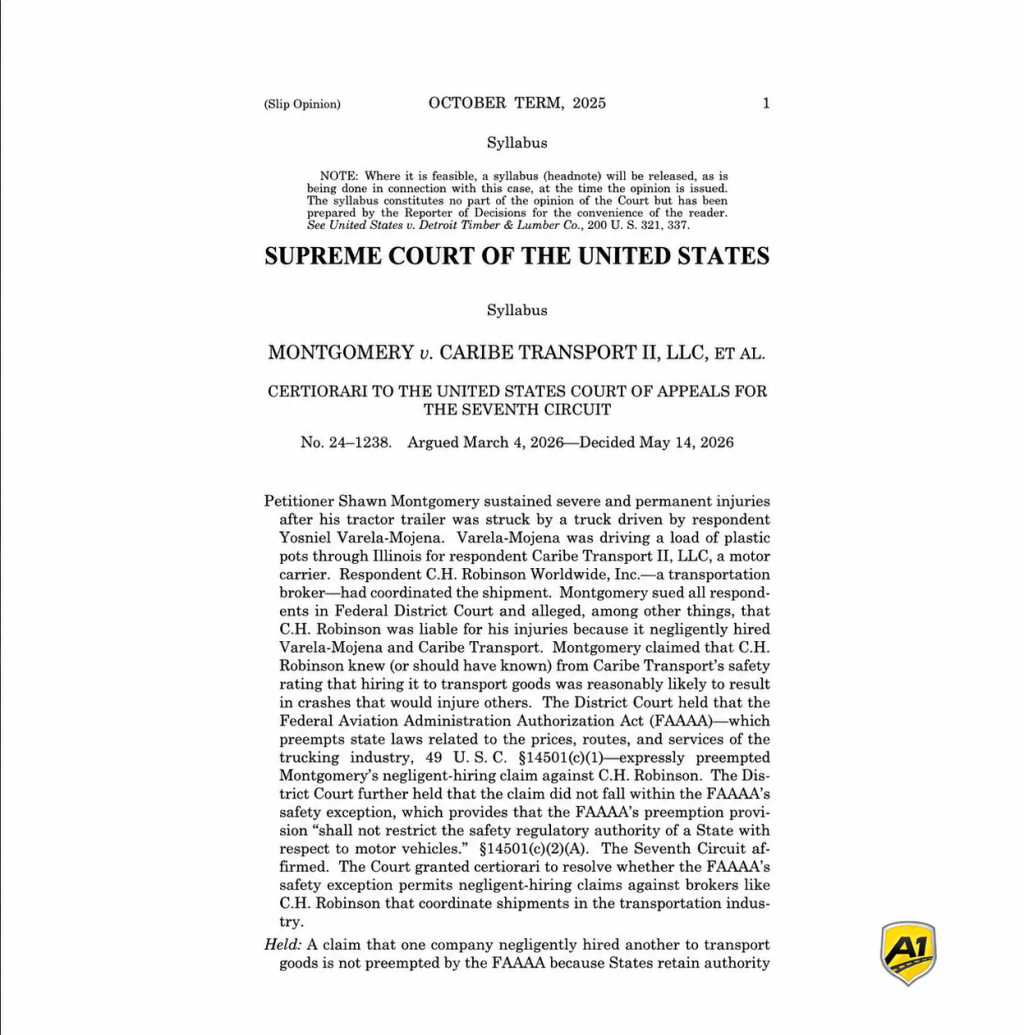
What the Supreme Court ruled in Montgomery v Caribe Transport
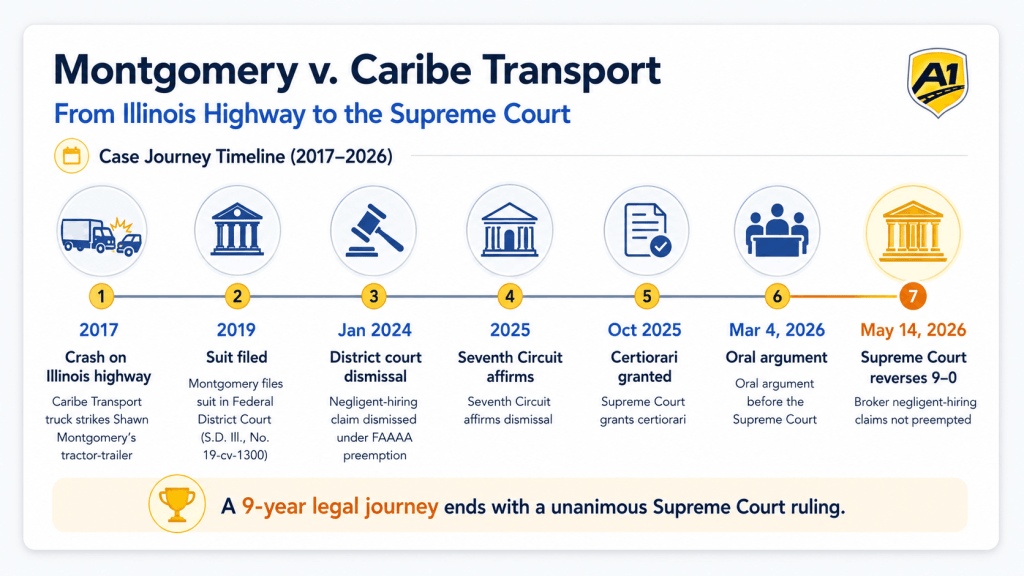
The case goes back to a 2017 crash on an Illinois highway. A truck driven by Yosniel Varela-Mojena, hauling plastic pots for motor carrier Caribe Transport II, veered off course and struck Shawn Montgomery's tractor-trailer on the shoulder. Montgomery lost part of his leg and sustained other permanent injuries. C.H. Robinson Worldwide, the country's largest freight broker, had coordinated the shipment.
Montgomery sued C.H. Robinson on a negligent-hiring theory. Caribe Transport carried a "conditional" safety rating from the FMCSA at the time of dispatch, with documented deficiencies in driver qualification, hours of service, vehicle maintenance, and recordable crash rate. Montgomery argued the broker either knew or should have known that putting Caribe Transport on the highway was reasonably likely to cause a crash and injure someone.
The District Court dismissed the claim under the Federal Aviation Administration Authorization Act (FAAAA), which preempts state laws related to the prices, routes, and services of the trucking industry. The Seventh Circuit affirmed. The Supreme Court reversed 9-0. Justice Barrett's opinion turned on a single statutory phrase. The FAAAA's safety exception, 49 U.S.C. §14501(c)(2)(A), preserves state authority to regulate safety "with respect to motor vehicles." As Justice Barrett wrote, a claim is "with respect to motor vehicles" if it "concerns the vehicles used in transportation." Requiring a broker to exercise ordinary care when selecting a carrier concerns motor vehicles, most obviously the trucks that will transport the goods. The Supreme Court broker liability ruling didn't invent a new federal claim. It removed the FAAAA preemption shield that had blocked these suits in some circuits. State negligence law now controls.
New Deals are now available for shipping all types vehicles using our vetted reliable shippers. Compare price estimates & Unlock up 25% off.
Why Montgomery v Caribe Transport resolves a circuit split that left customers in the dark
The case settled a real geographic problem. Before May 14, the FAAAA safety exception meant different things in different parts of the country.
In the Ninth Circuit (Miller v. C.H. Robinson) and Sixth Circuit (Cox v. Total Quality Logistics), courts read the exception broadly. Negligent-hiring claims against brokers could proceed because carrier selection affects motor vehicle safety on the road.
In the Seventh Circuit (Ye v. GlobalTranz) and Eleventh Circuit (Aspen v. Landstar Ranger), courts read it narrowly. Brokers don't own the trucks or employ the drivers, so the courts held that suits against them weren't the kind of safety regulation "with respect to motor vehicles" the exception protects.
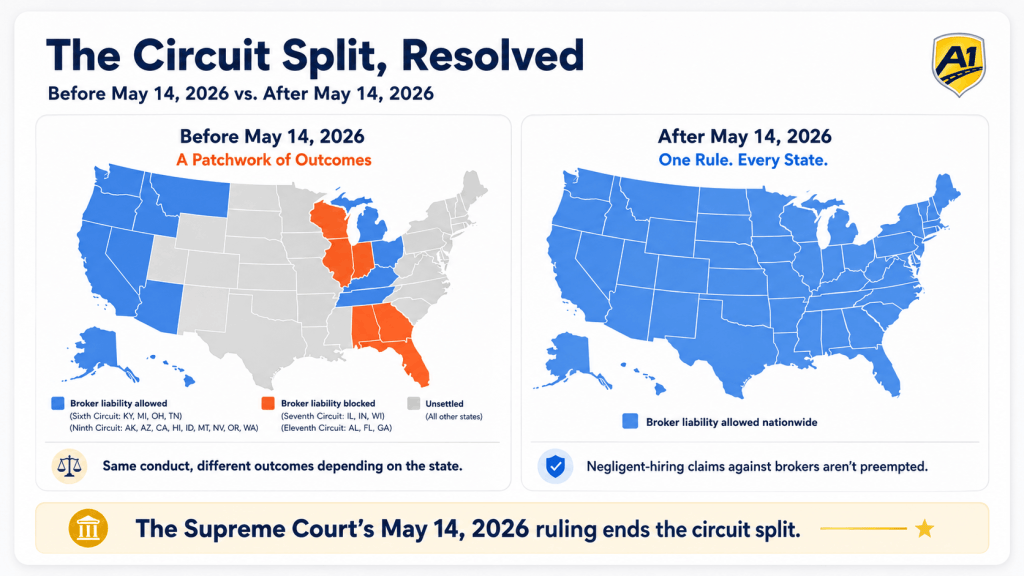
That created a problem any customer could feel. A broker that selected an undervetted carrier whose truck later caused a crash could be sued in California or Ohio and have the same claim tossed in Florida or Illinois. Customers in one circuit had a remedy the same customers in another didn't.
Montgomery ends the split. Brokers everywhere now operate under one rule: negligent-hiring suits aren't blocked by federal preemption. State courts will sort out the merits, applying their own negligence standards. For us and for our customers, the practical effect is straightforward. The same safety standard now applies whether your vehicle moves from Seattle to Phoenix or from Miami to Boston.
The limits Justice Kavanaugh drew on broker liability
The headlines moved fast and some of them moved sloppy. Montgomery doesn't make brokers automatically liable for every truck accident. Justice Kavanaugh's concurrence, joined by Justice Alito, took the unusual step of writing separately to draw the practical limits.
The decision, he wrote, should not mean that "brokers will routinely be subject to state tort liability in the wake of truck accidents." That single sentence does three things.
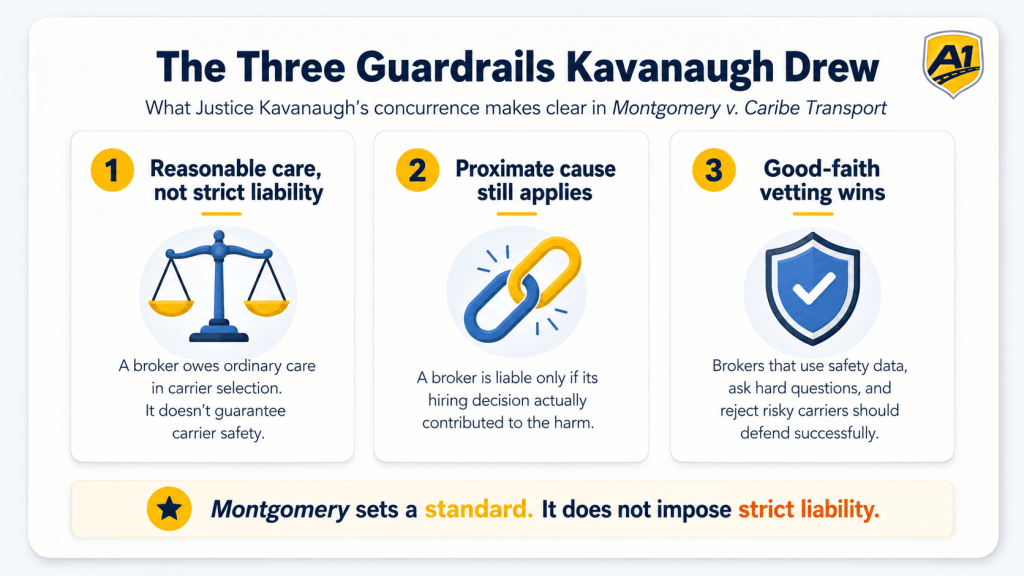
First, it confirms the standard is reasonable care, not strict liability. A broker doesn't owe a guarantee of carrier safety. It owes ordinary care in selecting a carrier given what's reasonably knowable.
Second, it preserves the proximate cause requirement of state negligence law. A broker can be tied to the crash only when its hiring decision actually contributed to the harm.
Third, it signals to lower courts that brokers acting in good faith should win on the merits. A broker that uses available safety data, asks hard questions of carriers, and refuses loads that fail its internal screens is doing what the law expects.
Montgomery rewards brokers that do real vetting. It doesn't penalize them. That has been our operating standard since we opened our doors.
What real broker carrier vetting looks like
Justice Kavanaugh laid out the standard. The industry has known the playbook for years. Real broker carrier vetting is a documented, repeatable process built around publicly available federal safety data and commercial monitoring tools.
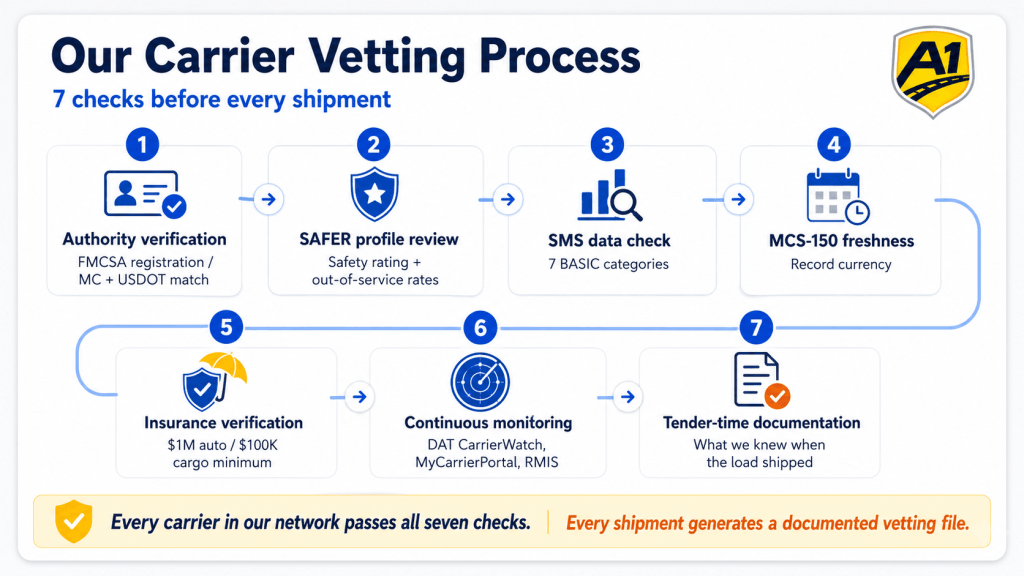
Every carrier we dispatch has active interstate operating authority verified against the FMCSA's registration system. We confirm the MC and USDOT numbers match the legal entity actually hauling the load. A mismatch between the paperwork and the truck on the road is one of the oldest red flags in the industry.
Before any dispatch, we pull the carrier's SAFER profile for safety rating and out-of-service rates, then check the Safety Measurement System (SMS) data across the seven BASIC categories. Unsafe Driving, Hours-of-Service Compliance, Driver Fitness, Vehicle Maintenance, and Crash Indicator carry the most weight. A "conditional" rating like the one Caribe Transport held when C.H. Robinson dispatched it triggers a manual review at minimum.
We also check MCS-150 freshness. Carriers are required to update their MCS-150 every two years. Stale records, sudden address changes, or mismatches between FMCSA filings and the carrier's own paperwork all get flagged.
On insurance, federal law sets a $750,000 floor for many for-hire interstate carriers. Our internal standard is higher. We verify $1 million auto liability and $100,000 cargo as a starting baseline, with proof confirmed through the producer or a monitored insurance platform, not a PDF the carrier forwarded.
Authority status, insurance, and safety scores all change. We monitor every active carrier in our network with industry tools like DAT CarrierWatch, MyCarrierPortal, and RMIS so we catch changes between initial vetting and dispatch.
The last piece is documentation at the time of tender. In a negligent-hiring case, the question is always what the broker knew when the load was tendered, not what the profile looked like six months later. We preserve a tender-time file for every shipment.
What Montgomery v Caribe Transport means when you ship a car
For someone shipping a personal vehicle in 2026, the ruling changes three things.
First, the carrier-vetting standard is now legally enforceable. What used to be a marketing promise on a broker's website is now a duty of reasonable care that a court can review after a crash. Brokers can't claim "we use vetted carriers" without being able to prove it. That's a good thing for customers. It separates companies with real systems from companies with stock photos.
Second, expect the auto transport broker market to consolidate. Smaller operators without documented vetting infrastructure, real insurance verification, or continuous monitoring face higher compliance costs, higher insurance premiums, and real auto transport broker liability exposure they didn't have last week. Better-resourced networks gain share. Customers benefit from concentration around operators that can actually meet the standard.
Third, pricing. The honest answer is that auto transport prices will move upward, but no one has a reliable industry figure 48 hours after the ruling. Compliance and insurance costs flow through to customer rates eventually. How much depends on the route, the carrier mix, and how the insurance market resets over the next few quarters. We quote your move based on the actual route, vehicle, season, and service level. That's been true for 25 years and it stays true today. A quote from us is still a quote, not a moving target.
Questions to ask any auto transport company after Montgomery
The ruling makes carrier vetting a real legal question, not a marketing one. The same questions that would matter in court are the ones you should be asking before you book.
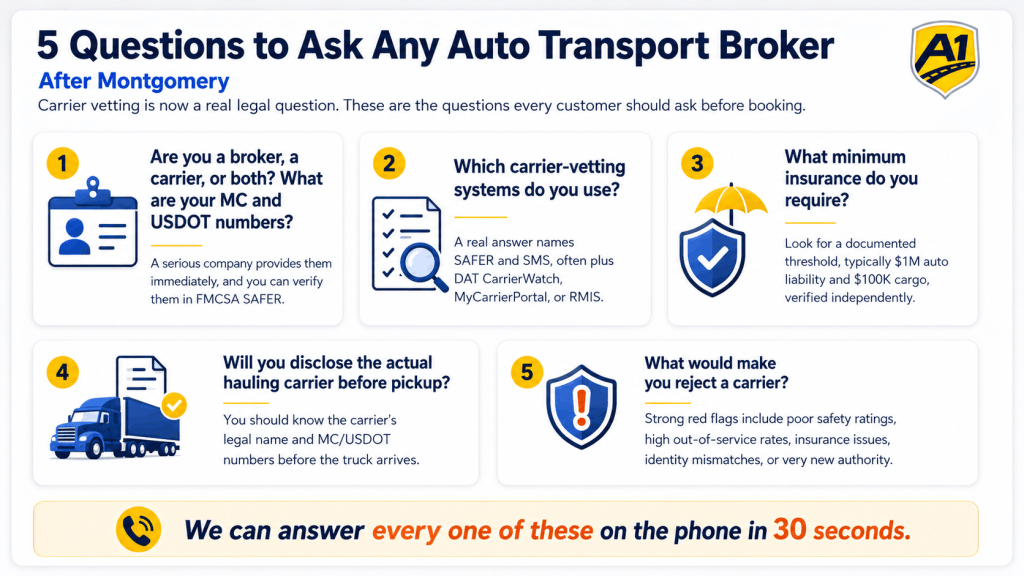
We can answer every one of these on the phone in 30 seconds.
The bottom line
Montgomery v Caribe Transport gives the auto transport industry one rule. The broker that picks the carrier owes a duty of ordinary care, and the FAAAA does not block that duty at the courthouse door. We welcome it. We have operated to that standard for more than 25 years.
If you're shipping a vehicle in the next 90 days, ask one thing. Can the company quoting your move tell you exactly how it vets the carrier that will haul your car?
For us, the answer is on the phone, on the screen, and in the contract. Get an instant quote and we'll walk you through the actual carrier verification we run for your route. Our full range of vehicle transport services covers every category from standard sedans to enclosed transport for high-value vehicles, and our pre-shipping checklist walks you through what to do before pickup day.
Frequently Asked Questions
Was Montgomery v Caribe Transport a unanimous decision?
Yes. The Court ruled 9-0 in favor of Montgomery. Justice Barrett wrote the opinion. Justice Kavanaugh filed a concurrence joined by Justice Alito to draw the practical limits on broker liability. The unanimous result resolved a real circuit split, and the unanimity also signals how clean the textual argument was once the FAAAA safety exception was applied to the language of §14501(c)(2)(A).
Does Montgomery v Caribe Transport apply to auto transport brokers?
Yes. Nothing in the opinion limits it to general freight brokerage. An auto transport broker that arranges motor carrier transport of a customer's vehicle for compensation fits the FMCSA's definition of a broker. The ruling reaches any company in that role.
Does this ruling make brokers automatically liable for every truck accident?
No. The standard is reasonable care, not strict liability. Justice Kavanaugh's concurrence said clearly that brokers acting in good faith with reputable carriers should defend successfully on the merits. State negligence law still requires proof of breach, causation, and damages.
Will auto transport prices go up because of this ruling?
Directionally yes, with no reliable industry figure available 48 hours after the decision. Higher compliance and insurance costs flow through the market over time. We continue to quote based on route, vehicle, season, and service level. A quote from us reflects the actual cost of moving your vehicle, not a speculative surcharge.
What is the FAAAA safety exception?
The FAAAA safety exception, codified at 49 U.S.C. §14501(c)(2)(A), preserves state authority to regulate safety with respect to motor vehicles. It is the carve-out the Supreme Court used in Montgomery v Caribe Transport to allow negligent-hiring claims against brokers to proceed under state law.

 Share on Facebook
 Share on LinkedIn
 Share on Twitter
 Dave C.
  Courtney J.
  Jeff D.
  Maria L.
  Google
  Instagram
  BBB
BBB