Morning Midas Car-Carrier Fire: What It Means for Safely Shipping Cars & EVs

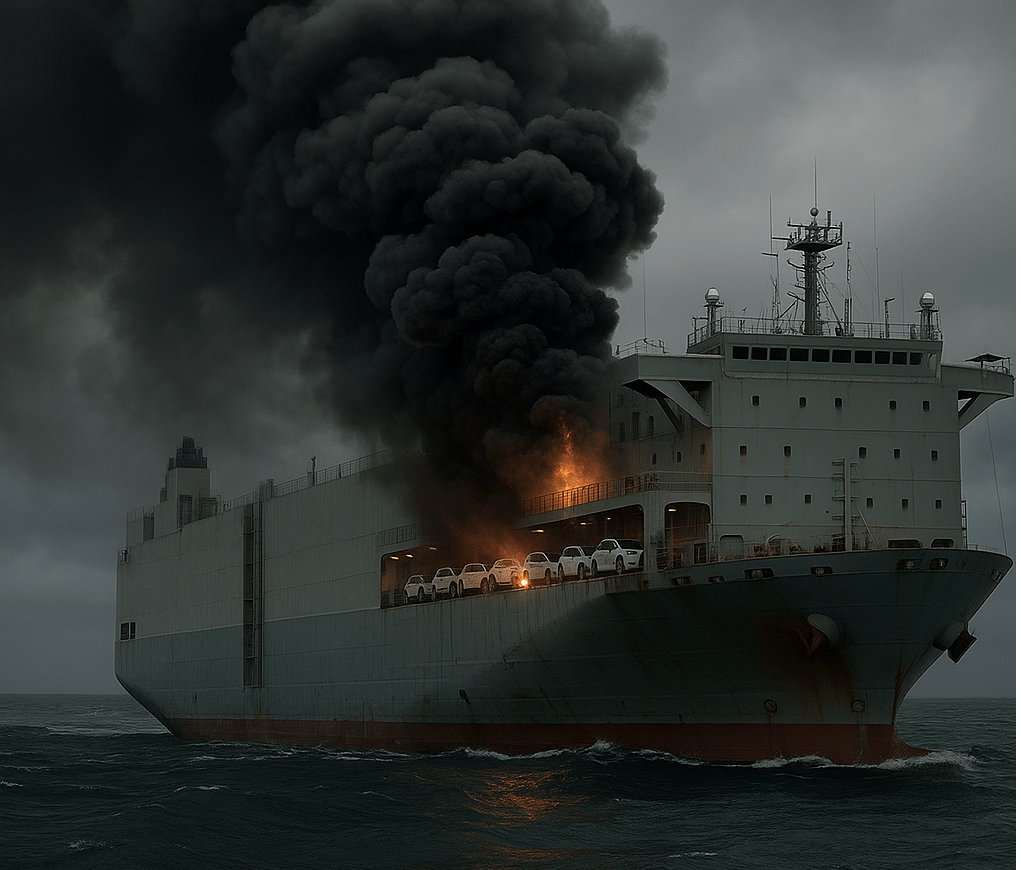
A Dramatic Wake-Up Call At Sea
Tragedies during overseas car shipping are unfortunate events causing heavy damages to the moving companies as well as auto manufacturers and owners. One such event took place in the pre-dawn hours of 3 June 2025 when the Panamanian-flagged car carrier Morning Midas radioed a MAYDAY after thick smoke erupted around a row of electric vehicles on Deck 8. The 19-year-old vessel—bound from Incheon to Lázaro Cárdenas with 3,048 brand-new cars, 70 of them fully electric and 861 hybrids—triggered its CO₂ system, but when the cylinders emptied the flames reignited with frightening speed. Captain Li Yan, faced with rising heat and toxic fumes, ordered an abandon-ship at 09:40 local time.
All 22 crew members scrambled into a lifeboat and were rescued unharmed by the passing container ship Cosco Hellas. A U.S. Coast Guard C-130 over-flight later captured sheets of flame ripping through the starboard weather deck while black smoke trailed a mile downwind. Adrift ≈ 340 nm southwest of Adak Island, Alaska, the unmanned vessel wallowed in 12-foot seas as winds gusted 25 knots. Salvage tugs Resolve Pioneer and Arctic Wolf departed Dutch Harbor on 5 June, but with an ETA of 9 June all anyone could do was watch via satellite while cargo valued near US $250 million continued to burn—an unfortunate chain of events that echoes the 2022 Felicity Ace disaster and again spotlights the challenges of lithium-ion fires at sea.
For anyone planning an international vehicle move, this real-time drama underscores both the size of today’s auto-shipping operations and the special hazards modern batteries introduce.
- The June 2025 Morning Midas fire destroyed cargo valued near $250 million, with 70 EVs triggering lithium-ion thermal runaway that reignited after CO₂ suppression systems emptied.
- EV battery fires at sea can extend international transit delays by days to weeks, as salvage operations and lane closures directly impact vessel schedules and rerouting across affected corridors.
- International maritime safety standards require carriers to verify battery state-of-charge at 20–30%, obtain accurate cargo declarations, and carry all-risk marine cargo insurance covering partial and total loss.
New Deals are now available for shipping all types vehicles using our vetted reliable shippers. Compare price estimates & Unlock up 25% off.
Why Lithium-ion Fires are so Stubborn?

Electric-vehicle (EV) and hybrid packs store huge energy in a tight space. If a cell is damaged—or overheats in transit—it can enter “thermal runaway,” generating intense heat, toxic smoke, and even explosions. Standard sprinkler or CO₂ systems aboard many older car carriers cannot always cool or starve a battery fire quickly enough. That is why the Morning Midas blaze, like the 2022 Felicity Ace fire that ended with the vessel sinking near the Azores, has insurers and ship operators re-evaluating fire-suppression layouts and emergency protocols.
What Incidents Like This Mean for You as a Car Shipper
| Potential impact | Why it matters |
|---|---|
| Longer transit or rerouting | Authorities may close lanes while salvage teams work. |
| Higher insurance exposure | Total loss claims on a single voyage can reach hundreds of millions of dollars. |
| Documentation scrutiny | Lines now demand exact battery specs and state-of-charge reports. |
| Limited sailings for EVs | Some carriers briefly restrict electric units after major fires. |
How A-1 Auto Transport Mitigate These Impacts
- We track every vessel and reroute at no cost if a scheduled carrier becomes unavailable.
- Every booking includes door-to-door marine cargo insurance with options up to the vehicle’s full invoice value.
- Our export desk prepares compliant battery declarations and verifies SOC ≤ 30 % before loading.
- We partner with multiple Ro-Ro and container operators so alternative sailings stay open.
5 Safety Checkpoints Before You Hand Over Your Keys

- Choose certified partners only. Ask for the vessel operator’s International Safety Management (ISM) number and their latest Port State Control record.
- Confirm battery preparation. EVs and hybrids should ship at 20–30 % charge, with the main breaker off.
- Declare aftermarket modifications. Non-OEM battery kits or audio amplifiers can invalidate insurance.
- Insist on all-risk coverage. “Total loss only” policies are cheaper but leave you exposed to partial-damage scenarios like smoke contamination.
- Track in real time. A-1’s dashboard pulls AIS and satellite pings every 30 minutes so you see route changes the moment they happen.
How the industry is adapting
- New fire-containment zones. Major Ro-Ro builders are installing deck-level water-mist curtains and remote-controlled monitors aimed directly at vehicle rows.
- Smarter cargo planning. EVs now load in dedicated lanes near topsides for easier venting; combustible items (tires, plastics) move away from battery decks.
- Training & drills. Crews practise “boundary cooling” and battery-specific firefighting methods every voyage, not just once a year.
These measures are already being retrofitted to vessels on our preferred-carrier list.
The A-1 Auto Transport Promise

We have shipped more than 190,000 cars worldwide—including over 12,000 EVs—without a single total-loss claim. Our in-house compliance team audits every Ro-Ro and container partner quarterly, and we never hesitate to switch carriers if a route presents elevated risk. The Morning Midas incident reinforces why that vigilance matters.
Key takeaways
- Fires at sea are rare but more challenging when lithium batteries are involved.
- Proper battery conditioning, honest declarations, and robust insurance are non-negotiable.
- Working with a broker who monitors safety ratings and provides multiple carrier options keeps your move on schedule—even when headlines say otherwise.
Have questions about shipping an electric or hybrid vehicle?
Call our 24/7 logistics desk, and let’s map out the safest, most cost-effective route for your car.
Sources
- Seatrade Maritime News, “Video – Car carrier Morning Midas adrift and on fire,” June 6 2025.- seatrade-maritime.com
- gCaptain, “A Brief Look Back at Recent Car Carrier Fires,” June 2025.(gcaptain.com)
- The Times (UK), “Sailors abandon ship as fire engulfs electric vehicles on board,” June 2025.(thetimes.co.uk)
Frequently Asked Questions
What happened in the Morning Midas car-carrier fire?
The Morning Midas caught fire in the North Pacific on June 3, 2025, was abandoned by its 22-person crew, and sank on June 23. The U.S. Coast Guard reported 3,048 vehicles aboard, including 70 fully electric and 681 hybrid vehicles; all 22 crew members were rescued with no reported injuries. The ship later sank in international waters about 450 miles southwest of Adak, Alaska, at a depth of roughly 16,400 feet. For background on the transport method, A1's international car shipping by sea guide explains how ocean vehicle shipments are normally handled.
What caused the Morning Midas car-carrier fire?
As of September 28, 2026, EMSA's current STARRS review still lists the Morning Midas fire's origin and cause as unknown. Early reports placed the first visible smoke or fire on a deck carrying electric vehicles, but that location does not establish that an EV battery started the fire. The ship was carrying conventional, hybrid, and fully electric vehicles. Claims that lithium-ion thermal runaway caused this specific casualty therefore go beyond the published investigation evidence.
Who owned and managed the Morning Midas?
The Morning Midas was a Liberian-flagged vehicle carrier managed by Zodiac Maritime when the fire occurred. U.S. Coast Guard records identify Zodiac Maritime as the vessel's manager, while marine casualty records list Hawthorn Navigation Inc. as the registered owner. The ship's IMO number was 9289910, which is the clearest identifier when comparing vessel records from different periods. The Coast Guard's corrected incident notice also confirms that the vessel was Liberian-flagged and U.K.-managed during the casualty.
Where did the Morning Midas sink?
The Morning Midas sank in international waters about 450 miles southwest of Adak, Alaska, after extensive fire damage was followed by water ingress. The U.S. Coast Guard reported a sinking depth of approximately 16,400 feet, or 5,000 meters. NOAA's incident record places the final area well outside the U.S. exclusive economic zone and hundreds of nautical miles from the nearest land. The vessel had been drifting in the North Pacific for nearly three weeks after the original fire.
Are electric vehicles more dangerous to ship by sea than gasoline cars?
Current research does not show that battery-electric cars are uniformly more dangerous to ship than comparable gasoline cars, but their batteries create different firefighting challenges. EMSA's STARRS review found broadly comparable peak heat release in several similar-size BEV and internal-combustion vehicle tests, while identifying thermal-runaway gases, re-ignition, and battery access as important EV-specific concerns. The practical focus is early detection, cooling, and limiting fire spread between vehicles. A1's electric car shipping guide covers broader EV transport considerations.
How are vehicle carriers protected against fires at sea?
Vehicle carriers use layered fire protection, but the equipment depends on the ship's design and its vehicle spaces. SOLAS sets fire-safety requirements for vehicle and ro-ro spaces, while EMSA notes that pure car carriers often rely on fixed gas-based suppression rather than the water-based systems used in some other ro-ro applications. IMO work in 2026 identified priority measures for ships carrying battery-electric vehicles, with mandatory BEV-focused provisions targeted by 2032. A1's international car shipping guide explains the wider overseas vehicle-shipping process.

 Share on Facebook
 Share on LinkedIn
 Share on Twitter
 Dave C.
 Courtney J.
 Jeff D.
 Maria L.
 Google
 Instagram
 BBB